
A single unlicensed stock photo buried in a client deliverable from eighteen months ago can trigger a five-figure demand letter. Creative agencies juggle hundreds of assets every month across Shutterstock, Adobe Stock, Envato, Freepik, iStock, and more. Without a systematic way to verify that every image, icon, and video clip carries valid proof of licence, compliance becomes a gamble. Regular license audits turn that gamble into a controlled, repeatable process that protects the agency, its clients, and its bottom line.
Photo by qmicertification design from Pexels
TL;DR:- Regular license audits give creative agencies a single source of truth for every stock asset used across client projects.
- Audits catch expired, misattributed, or missing licences before a copyright holder or client legal team does.
- A structured audit process reduces legal exposure, speeds up compliance responses, and builds long-term client trust.
Why license audits matter for agencies
Most agencies do not lose compliance battles because they intentionally cut corners. They lose because assets move through too many hands. A designer downloads an image on a personal Freepik account, drops it into a shared Figma file, and six months later nobody can trace the licence back to a valid purchase. Multiply that by dozens of projects and several freelancers rotating through the roster, and the risk compounds fast.
A license audit is the antidote. It forces the team to reconcile what was used against what was purchased, flag gaps, and fix them before they become legal problems. Agencies that audit quarterly instead of annually catch discrepancies while the trail is still warm and the cost of correction is low.
What does an agency license audit look like?

The process is straightforward on paper and messy in practice. Here is the core loop:
- Inventory all stock assets used in a given period (quarter, campaign, or client engagement).
- Match each asset to a valid licence certificate or proof-of-purchase record.
- Flag any asset that lacks documentation, has an expired licence, or was downloaded under the wrong account or licence tier.
- Resolve flagged items by locating the missing proof, re-purchasing the asset, or replacing it.
- Archive the verified records in a central, searchable location.
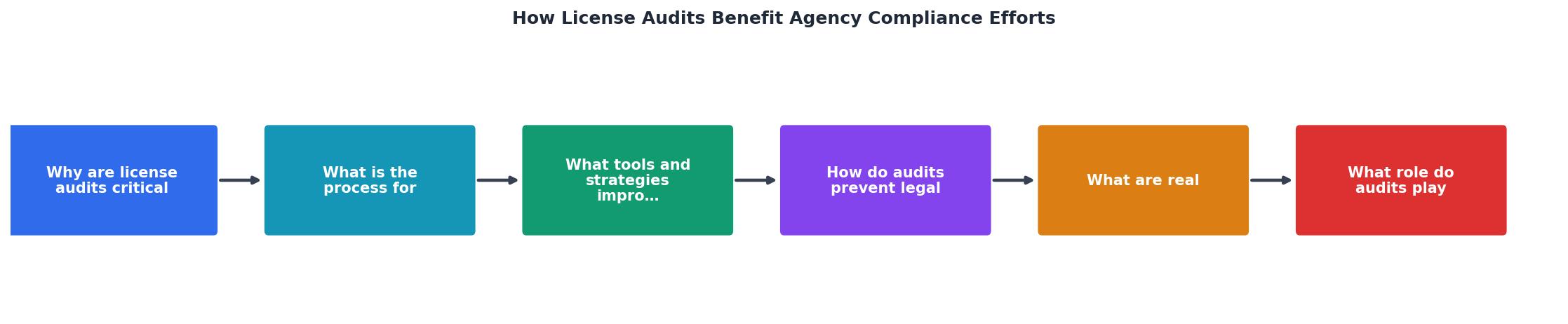
The steps in the diagram (Inventory, Match, Flag, Resolve, Archive) repeat every audit cycle. Each cycle gets faster because the backlog of unverified assets shrinks. The first audit is always the hardest. After that, you are only auditing net-new assets plus anything that changed.
Tools and strategies for efficient audits
Manual audits work for a five-person studio with a handful of Canva downloads. They collapse at agency scale. Here are the tools and strategies that keep audits manageable:
- Centralized asset management. Platforms like Bynder, Brandfolder, or even a well-structured Google Drive give every asset a home. Tag each file with its licence source and expiry date.
- Bulk licence retrieval. Logging into six different stock platforms and downloading certificates one by one is a time sink. Tools like Licence Downloader let you bulk-find and download licence certificates from Shutterstock, Adobe Stock, Freepik, Envato, iStock, and others in one pass.
- Spreadsheet or database tracking. A simple sheet mapping asset filename, project, platform, licence type, download date, and certificate link covers most needs. Graduate to Airtable or Notion databases when the volume justifies it.
- Automated reminders. Set calendar triggers for quarterly audits. Tie them to your project management tool (Asana, Monday, ClickUp) so they land on someone's task list, not just an inbox.
| Manual Audit | Tool-Assisted Audit |
|---|---|
| Log into each platform separately | Pull certificates from multiple platforms at once |
| Copy-paste filenames into a spreadsheet | Auto-match assets to licence records |
| Hours per client project | Minutes per client project |
| High error rate at scale | Consistent, repeatable results |
How audits prevent legal issues

Copyright enforcement has become industrialized. Companies like Pixsy, Copytrack, and PicRights use reverse-image search at scale to find unlicensed usage and send demand letters. The typical settlement range for a single image runs from $750 to $5,000. For an agency using hundreds of assets per month, even a small percentage of unlicensed usage adds up to serious financial exposure.
Audits prevent these scenarios in three concrete ways:
- Early detection. An audit surfaces the unlicensed asset before an enforcement company does. Fixing it proactively costs the price of a licence. Fixing it reactively costs the price of a settlement plus legal fees.
- Proof of good faith. If a dispute does arise, having a documented audit trail shows that the agency takes compliance seriously. Courts and enforcement agencies treat good-faith actors differently from repeat infringers.
- Freelancer accountability. When freelancers know their asset usage will be audited, they are far more likely to use properly licensed content from the start. The audit itself changes behavior.
"The findings from compliance audits can significantly impact a healthcare organization's operations and business.">, Agencies Who Audit for Healthcare Compliance
That observation from the healthcare compliance world applies directly to creative agencies. Audit findings do not just fix past mistakes; they reshape how the entire organization handles licences going forward.
Real-world audit wins

Consider a mid-size digital marketing agency running campaigns for e-commerce brands. They use Adobe Stock for hero images, Envato Elements for motion graphics templates, and Freepik for social media illustrations. Three platforms, two team accounts, and four freelancers with their own subscriptions.
Before implementing quarterly audits, this agency received two copyright demand letters in a single year. Both traced back to assets a freelancer had downloaded from a free-tier account without a commercial licence. Total cost: over $6,000 in settlements plus legal consultation fees.
After introducing a structured audit process:
- They built a shared Airtable base linking every deliverable to its source asset and licence certificate.
- They used bulk licence retrieval to pull certificates from all three platforms at the end of each quarter.
- They added a clause to freelancer contracts requiring licence proof submission with every deliverable.
Another example: a branding agency with 30 employees adopted a policy of auditing licence records before every major client presentation. The five-minute pre-delivery check caught three instances of expired Shutterstock trial licences in the first month alone. Each would have been a liability if the client's legal team had requested documentation.
The following dashboard illustrates what a typical agency compliance snapshot looks like after implementing quarterly audits:
Quarterly Audit Snapshot (Example: 30-Person Agency)
Audits as a risk management tool
License audits are not just about catching mistakes. They feed directly into the agency's broader risk management framework.
Onboarding and offboarding. When a freelancer or employee leaves, their personal stock accounts go with them. An audit conducted at offboarding ensures every asset they contributed has a licence record that the agency controls. Without this step, the agency inherits usage rights it cannot prove.
Client transitions. When a client moves to a different agency, they sometimes request full documentation of every asset used during the engagement. Agencies with clean audit records hand over a folder and move on. Agencies without them spend days reconstructing history from email threads and platform dashboards.
Insurance and legal preparedness. Some professional liability (E&O) insurance policies ask about compliance processes during underwriting. A documented audit cadence can strengthen the agency's position and potentially reduce premiums.
Step-by-step agency audit guide
Agency License Audit Checklist
Your progress is saved automatically in your browser.
FAQ
Frequently Asked Questions
What does your agency's current audit process look like, and where does it break down? Share your experience in the comments.
Additional Resources
- Keeping Your Insurance Agency Audit-Ready - Learn proven strategies to keep your insurance agency compliant and audit-ready, plus how AgencyBloc's CRM automates documentation and ...
- Agencies Who Audit for Healthcare Compliance - Compliance audits are critical to healthcare management, ensuring that healthcare organizations adhere to legal and regulatory standards.
- What Is a Compliance Audit? - A compliance audit is an impartial review of an organization's activities and records to verify adherence to internal and external policies, standards and ...